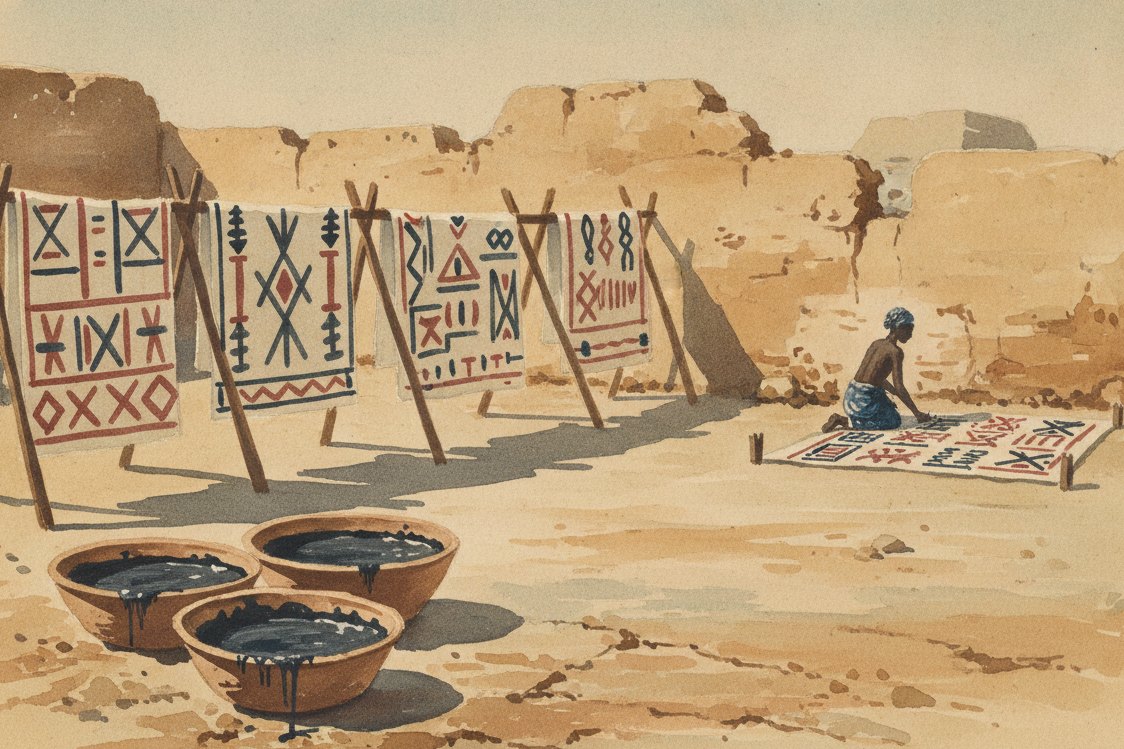
Pale geometric symbols left as the ground while the mud darkens around them.
- First documented
- 1800s
- Origin
- Mali, Mali
- Fiber
- cotton
- Weave
- cotton hand-painted with fermented mud over a leaf dye
- Family
- prints
Plate No. 162 · fabric
Mud Cloth
Mud cloth, in Bambara bogolanfini, is the hand-painted cotton of Mali, patterned not by weaving or printing but by dyeing with mud. The woven cloth is first steeped in a tannin-rich leaf solution, then a craftsperson paints fermented, iron-rich mud onto it, and where the mud meets the tannin it reacts and fixes a deep brown-black. The pale geometric symbols are usually the negative, left as the ground while the area around them is darkened stroke by stroke. Made traditionally by Bamana women, the symbols carry proverbs, status, and protection, and the cloth has become both a national emblem of Mali and a globally borrowed design.
Named for
From the Bambara bogolanfini: bogo, earth or mud, lan, with, and fini, cloth, cloth made with mud.
Often confused with
From the journal
Sources & References
- 1.Bogolanfini, Wikipedia
- 2.Resist dyeing, Wikipedia