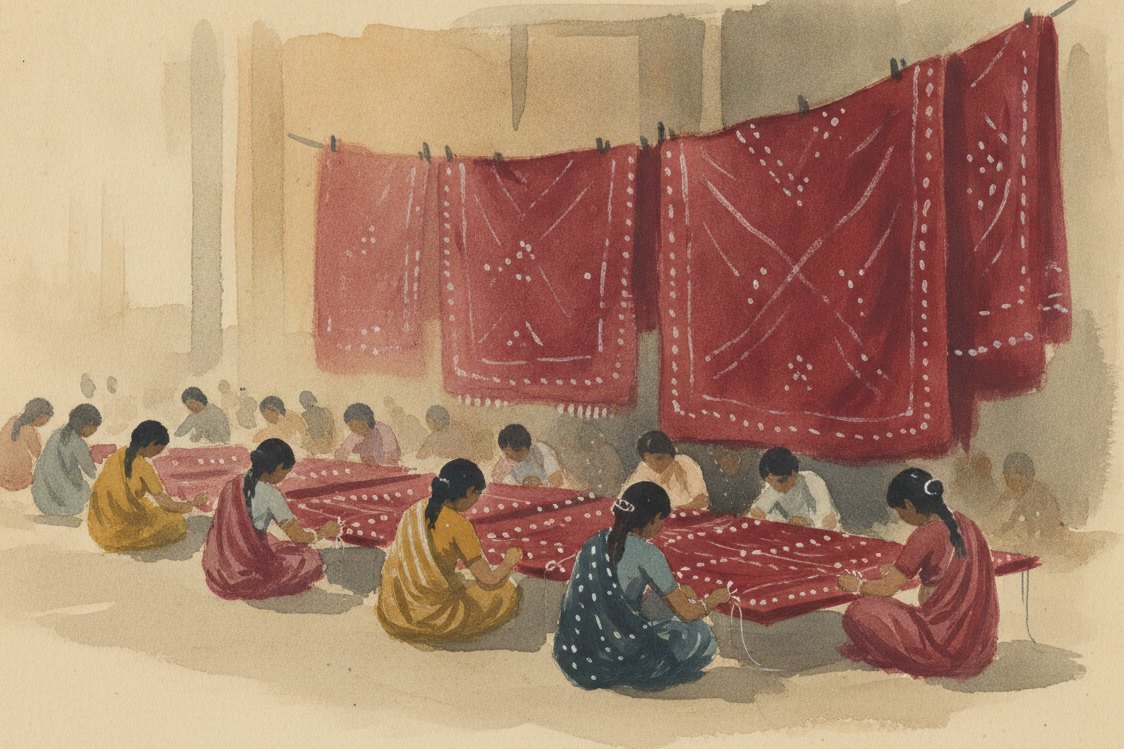
Tiny undyed dots where each knot resisted the dye.
- First documented
- Antiquity
- Origin
- Gujarat and Rajasthan, India
- Fiber
- cotton, silk
- Weave
- tie-resist of thousands of tiny knots
- Family
- prints
Plate No. 155 · pattern
Bandhani
Bandhani is the fine Indian tie-resist, in which a worker plucks up tiny points of cloth and binds each with thread before dyeing, so that thousands of minute knots stay undyed and bloom as small light dots once the bindings are cut. Centered in Gujarat and Rajasthan and among the oldest tie-dye traditions, evidence of it reaches back to the dawn of Indian dyeing, it patterns the bright saris, turbans, and odhani veils of western India, the density and arrangement of the dots carrying regional and ceremonial meaning. The related leheriya twists the cloth into diagonal waves by the same resist principle.
Named for
From the Sanskrit bandh, to tie or bind, for the countless tied knots that make the pattern.
Often confused with
Sources & References
- 1.Bandhani, Wikipedia
- 2.Resist dyeing, Wikipedia